6 Things To Check Before You Buy A "Copper" Pan


About the author
Daniel Hart spent years as a chef in kitchens across the world, where a pan was judged on one thing: whether it survived another service. Most didn't. Somewhere between the scorched nonstick and the copper-coloured pans that quit after three uses, he stopped trusting labels and started reading what a pan is actually made of. Today he writes for people who want the real thing, described honestly.
Many pans sold as copper, actually weren't
Search "copper pan" and many of the results are copper-coloured paint on a thin body with a nonstick spray inside. Their own reviews read the same way: great for three uses, then everything sticks, then the centre warps. Here is how to tell that pan from a real one, and what we built instead.
Check #1
Copper-coloured is not copper
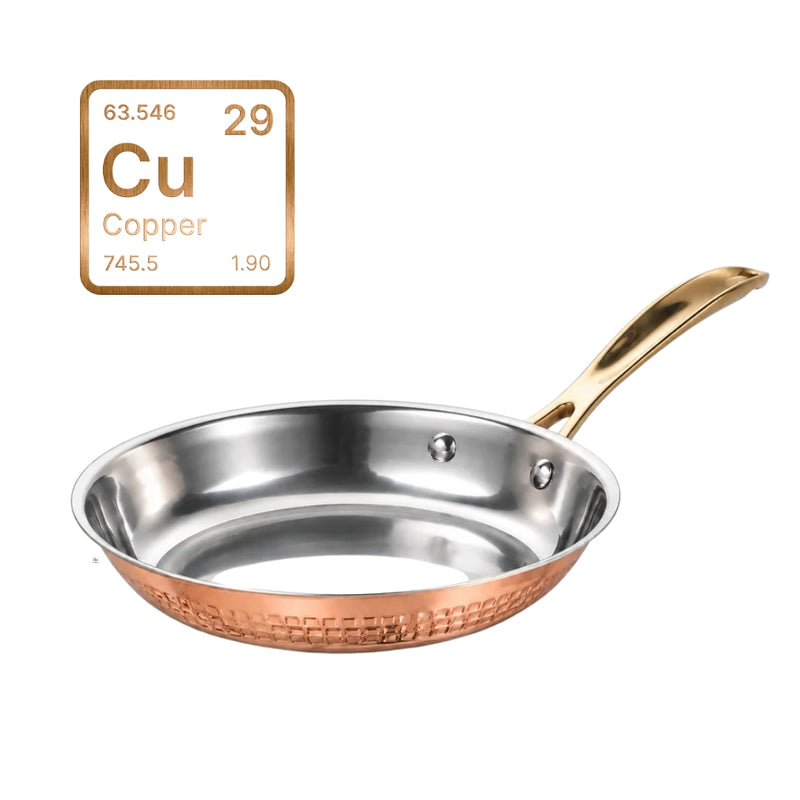
The pan from the TV ad has a copper-coloured coating on the outside. Buyers who scraped it found a thin foil or paint over a plain metal body, which is why "not as advertised" comes up again and again in that tier's reviews.
Ours has real copper on the outside, not paint. Scrape it and it is still copper, because it is metal, not a finish. Copper on the outside, a multi-metal body underneath, and a non-reactive cooking surface with nothing sprayed on it.
We describe the body rather than list it, the same way we do for our titanium pans, and we say so plainly instead of pretending the whole pan is one metal.
Is the outside real copper?
Yes. Real copper on the outside, not plating, foil or paint. It will darken with use, which paint cannot do, and that is the quickest tell between the two.
Why don't you list the layers?
Because a layer list invites a thickness contest and tells you nothing about how the pan cooks. What we put in writing is the construction as a whole and the things it lets the pan do: work on induction, spread heat across the base, take acidic food.
Check #2
What is sprayed on the inside
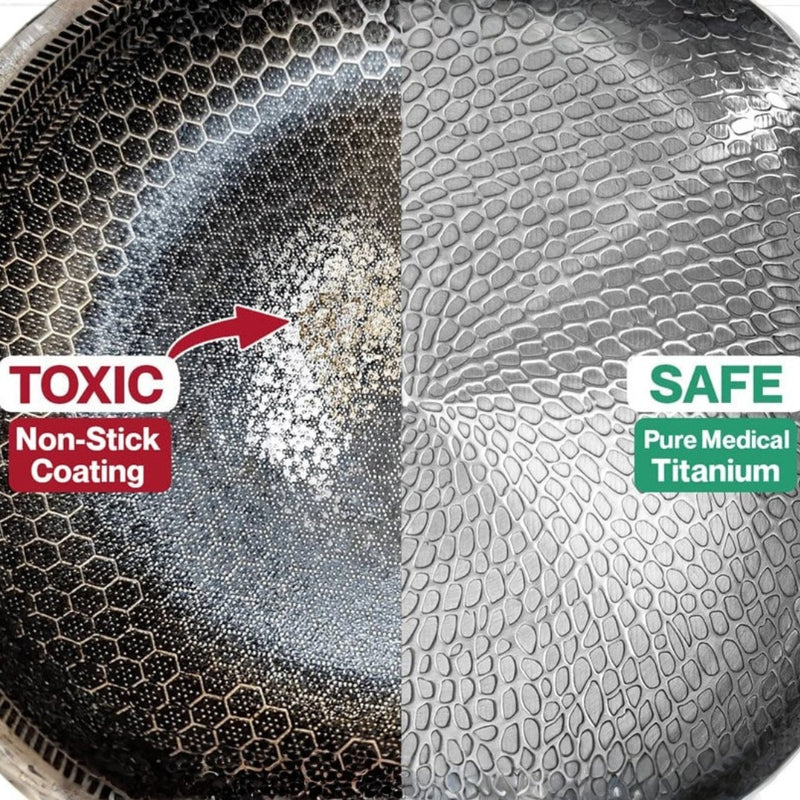
The copper-coloured pan gets its slipperiness from a nonstick spray, and a spray has a service life measured in uses. "Worked well the first three times I used it, thereafter food sticks" is the most-voted review on the best-known listing in that tier for a reason.
Our cooking surface has nothing sprayed on it. It is bare, non-reactive metal, so there is nothing to wear off. It is not nonstick. You cook on it the way you cook on any real pan: a little oil, proper heat, a real sear.
We would rather tell you that here than have you find out in the kitchen. A pan that is honest about how it cooks is the pan that still cooks the same way in year five.
So food will stick?
Not if you cook on it like a real pan. Heat it first, add oil, let the food release when it is ready. It is closer to any good bare-metal pan than to a coated pan, and it never changes, because there is nothing on it to change.
Check #3
What is underneath
Copper on its own has two problems in a modern kitchen: it will not work on induction, and lined with tin it needs re-tinning. That is why this pan is built as a body, not a single metal.
Ours is copper on the outside with a multi-metal body underneath that spreads the heat across the base and lets the pan work on induction, gas and electric. The cooking surface is non-reactive, so tomatoes, lemon and wine are fine.
No tin anywhere in the pan. Nothing to melt, nothing to wear through, nothing to send away for re-lining.
What is the core made of?
A multi-metal body. We describe it as a whole rather than as a list, and we say that up front. What matters is what it does: it spreads heat across the base and works on induction.
Does the whole base work on induction?
Yes, the base is induction compatible. A copper-coloured pan that only heats in the centre on induction is the category's documented failure; that is exactly what we built against.
Check #4
It darkens. Paint does not.

Here is a tell nobody in the category mentions before the sale: real copper tarnishes. Out of the box it is bright; with use it goes warmer and deeper. A copper-coloured pan stays exactly the same colour until the coating chips, because it was never copper.
It will darken with use, because that is what real copper does. Two minutes with lemon and salt brings it back, or leave it.
We put this on the page before you buy because the category taught people that bright copper is the product. It is not. The metal is the product, and this is what the metal does.
How do I get the shine back?
Half a lemon and a pinch of salt, two minutes, rinse and dry. Or leave it and let it age; both are correct.
Is tarnish covered?
Tarnish is not a defect, and we say so. If you decide copper is not for you, the normal returns window applies anyway.
Check #5
Real customers. Real reviews.
GONEST customers aren't impulse buyers. They're the people with six tabs open, asking the uncomfortable questions: is the outside real copper, what is underneath, does it work on induction, is it nonstick? They buy because the answers hold up to checking, not because a label asks them to believe.
These are real reviews from real customers of this exact copper range, in their own words: "Not another copper-colored pan. Copper pan is what I expected the time I bought a "copper" pan. Real copper on the exterior of copper pan, a build and no coating sprayed over the cooking surface of copper pan." Copper is not new to our customers.
And you can run your own check: try it for 30 days. Cook on it, deglaze in it, scrape the outside if you like. If it isn't what we've said it is, send it back.
What do copper buyers say about GONEST?
"Not another copper-colored pan. Copper pan is what I expected the time I bought a "copper" pan. Real copper on the exterior of copper pan, a build and no coating sprayed over the cooking surface of copper pan.", Sarah M., verified buyer | "You can tell the difference. I was skeptical because I have been disappointed by copper pans before. Copper pan immediately feels like a piece of cookware rather than another lightweight TV pan.", Daniel F., verified buyer
Are these real reviews?
Yes. Every review on this page is from a real customer of this copper range, in their own words.
Check #6
Does it work on your hob?
Copper pans are famous for one rule: gas only. Induction cooktops are a large and growing share of kitchens, and a pan that fails on them is a pan a lot of people simply cannot use.
Ours works on induction, gas and electric. The copper is where the heat arrives, on the outside, and the multi-metal body underneath is what makes the base work on an induction hob.
If you have been told copper is not for your kitchen, this is the pan that rule does not apply to.
Gas, electric or induction?
All three. The base is induction compatible, and it works on gas and electric as well.
See who went before you
Reviews from verified buyers
No coating to baby. I wanted to move from cookware where I am constantly worrying about damaging the surface. Copper pan feels more like a proper everyday pan.
Looks even better after use. Copper has started darkening and I love it. Instead of looking worn out, copper pan looks like a copper pan that actually gets used.
Finally replaced my nonstick. I kept going to my old skillet because previous replacements disappointed me. After getting used to the heat on copper pan the old pan has finally stayed in the cupboard.
A different kind of copper pan. If your only experience with copper cookware is the lightweight orange pans sold online do not judge copper cookware by those. Copper pan is worlds apart.
Last chance to save...
This limited-time deal is in high demand.
Frequently asked questions
1. Is the outside real copper, or plated?
Real copper, not paint, foil or plating. That is the difference between this and the pan from the TV ad, whose own reviews say the colour lifts and the centre warps. Ours is built to be used and to darken, which paint cannot do.
2. What is the body made of?
Copper on the outside, a multi-metal body underneath that spreads the heat across the base, and a non-reactive cooking surface with nothing sprayed on it. We describe the construction as a whole rather than as a layer list, the same as we do for our titanium pans, and we would rather say that plainly than pretend otherwise.
3. How thick is the copper?
We do not publish layer measurements for any pan we sell, titanium included. What we put in writing is the construction: real copper on the outside, a multi-metal body, a non-reactive cooking surface with nothing sprayed on it, and a base that works on induction.
5. Does it work on induction?
Yes. The base is induction compatible, and it works on gas and electric as well. That is the one thing a copper pan is not supposed to do.
6. Will it tarnish?
Yes. Copper darkens with use and so will this pan, and we would rather tell you now than after. Two minutes with lemon and salt brings the shine back, or leave it and it turns a warm brown. Paint stays bright. Copper does not. That is how you tell them apart.
7. Can I cook tomatoes, lemon and wine in it?
Yes. The cooking surface is non-reactive, so acidic food is fine. There is no tin lining to wear through, so there is nothing to melt, nothing to re-tin and no point where the copper starts touching your food.
8. How do I look after it?
Hand wash with warm water and a little soap, and dry it rather than leaving it to drip. Lemon and salt when you want it bright.
© Gonest
Real copper on the outside. Nothing sprayed on the inside. Honestly described.