6 Rules Of Copper Cookware That Don't Apply To This Pan


About the author
Daniel Hart spent years as a chef in kitchens across the world, where copper meant gas burners, a tinsmith on speed dial and a polishing rota nobody enjoyed. He still loves what copper does on a hob and still thinks most home kitchens should never have to do the homework. Today he writes for people who want the pan without the list.
You already know the rules of copper
Not on induction. A tin lining that melts if you run it too hot and wears through if you don't. No tomatoes once it does. Polish it or watch it go brown. Send it away for re-tinning, if you can still find someone who does it. Every one of those rules is true of traditional copper. All but one are false of this pan.
Rule #1
"Copper does not work on induction"
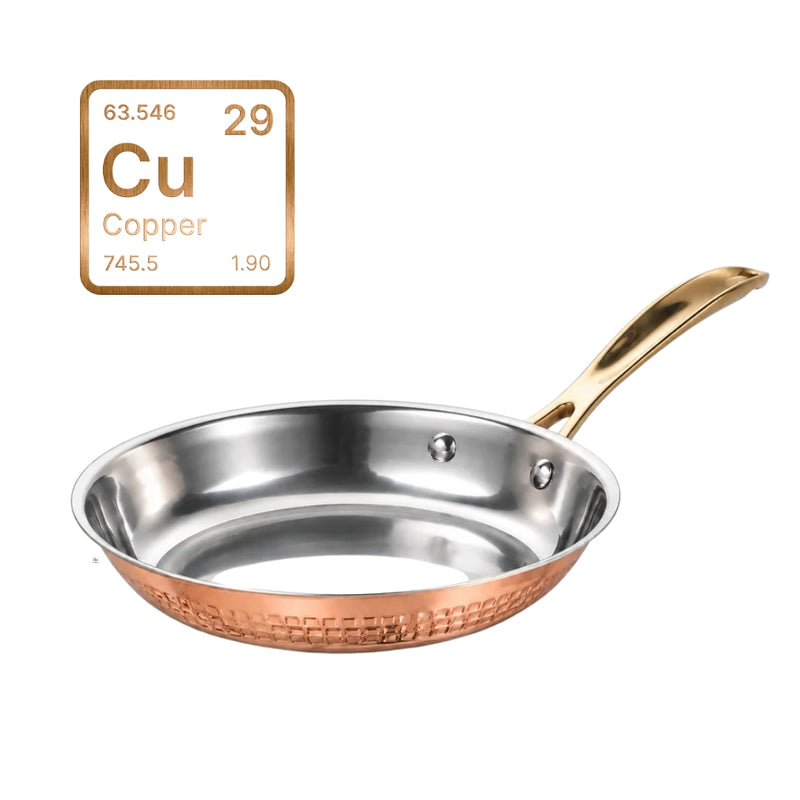
True of traditional copper. Copper is not magnetic, so a solid copper pan sits cold on an induction hob, and every recommendation thread says the same thing: unless you cook on gas, don't even think about it.
Ours has a multi-metal body underneath built for exactly this. The base is induction compatible, and it works on gas and electric as well. The copper stays where it belongs, on the outside, where the heat arrives.
If your kitchen has an induction hob and you wanted copper anyway, this is the one that rule does not apply to.
Is the whole base induction compatible?
Yes. Not a centre disc; the base works on induction, and on gas and electric.
Does it spread heat well on induction?
The multi-metal body is built to spread heat across the base. It behaves like a good clad pan on induction, not like a solid copper pan on gas.
Rule #2
"The tin lining melts and wears through"
True of traditional copper. Copper cannot be a cooking surface, so it is lined with tin. Tin melts just above the smoke point of cooking oil, it cannot take a metal utensil, and it wears through with use.
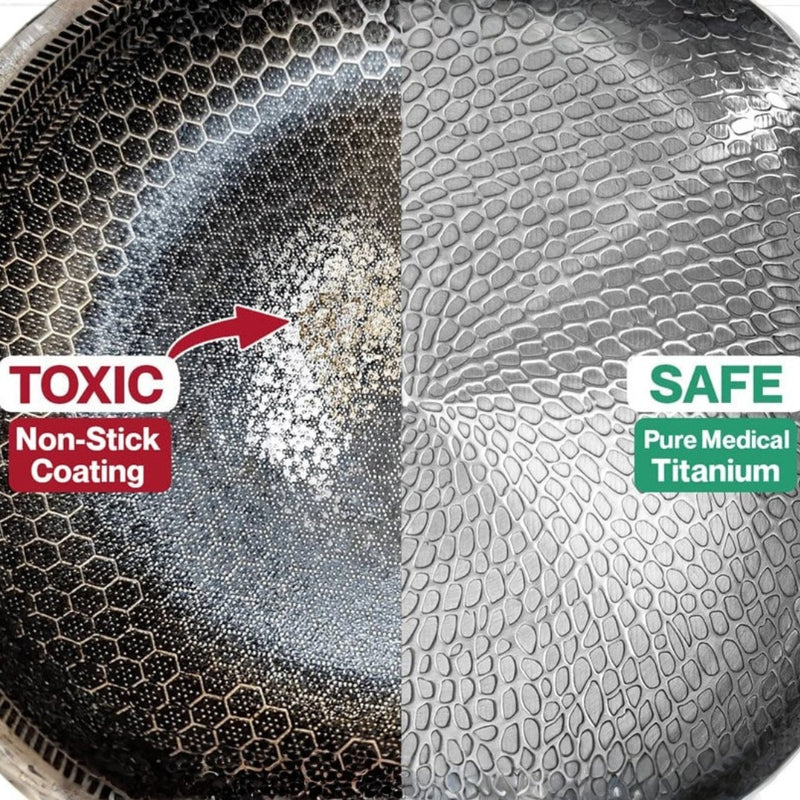
Ours has no tin anywhere. The cooking surface is bare, non-reactive metal with nothing sprayed on it, so there is nothing to melt and nothing to wear through. It is not nonstick. You cook on it the way you cook on any real pan: a little oil, proper heat, a real sear.
That last part matters. Tin is slick when new, and it is soft: it melts just above the smoke point of oil and it wears through. We chose the surface that lasts over the surface that slides, and we tell you how to cook on it.
Is the surface coated?
No. Nothing is sprayed on it. Bare metal, non-reactive, and it is not nonstick: heat first, then oil, then food.
Will food stick?
Not if you heat the pan before the oil goes in and let food release when it is ready. It cooks like any good bare-metal pan, and it cooks the same way in year five.
Rule #3
"No tomatoes, no lemon, no wine"
True of traditional copper once the tin wears through: bare copper reacts with acidic food. It is why every guide to copper pans comes with a list of what not to cook in them.
Ours has a non-reactive cooking surface, so acidic food is fine. Tomato sauce, a squeeze of lemon, a splash of wine to lift the fond after a sear. There is no point at which the copper starts touching your food, because it never does.
Copper's job in this pan is heat, and heat arrives from the outside. That is where our copper is.
Does copper touch my food?
No. The copper is on the outside. The cooking surface is non-reactive metal, and acidic food is fine.
Rule #4
"Polish it or watch it go brown"

This is the one rule that stays, and we would rather say it than hide it. Real copper darkens with use. Out of the box it is bright; after a few weeks it is warmer and deeper. Traditional copper owners polish to fight that. You do not have to.
It will darken with use, because that is what real copper does. Two minutes with lemon and salt brings it back, or leave it. A pan that looks like it gets used is not a defect. It is copper doing what copper does.
The category sells bright copper and lets you discover the rest in the box. We put it on the page.
Can I keep it bright?
Yes: two minutes with lemon and salt, then rinse and dry. Or let it age. Both are correct.
Is tarnish a fault?
No, and we say so before you buy. If copper turns out not to be for you, the normal returns window applies.
Rule #5
Real customers. Real reviews.
GONEST customers aren't impulse buyers. They're the people with six tabs open, asking the uncomfortable questions: is the outside real copper, what is underneath, does it work on induction, is it nonstick? They buy because the answers hold up to checking, not because a label asks them to believe.
These are real reviews from real customers of this exact copper range, in their own words: "Not another copper-colored pan. Copper pan is what I expected the time I bought a "copper" pan. Real copper on the exterior of copper pan, a build and no coating sprayed over the cooking surface of copper pan." Copper is not new to our customers.
And you can run your own check: try it for 30 days. Cook on it, deglaze in it, scrape the outside if you like. If it isn't what we've said it is, send it back.
What do copper buyers say about GONEST?
"What I was looking for. I love copper but never wanted to deal with tin linings and re-tinning. Copper gives me the copper exterior I wanted with a more practical cooking surface.", Emma R., verified buyer | "No tin lining to worry about. I researched copper for months and kept talking myself out of it. Not having a tin lining was what finally made this version practical enough for me.", Jack M., verified buyer
Are these real reviews?
Yes. Every review on this page is from a real customer of this copper range, in their own words.
Rule #6
"Copper is for professionals"
Traditional copper earned that reputation honestly: gas only, a lining to protect, a polishing habit, a re-tinning schedule. It is a fine thing on a gas hob for someone who enjoys the upkeep, and we mean that.
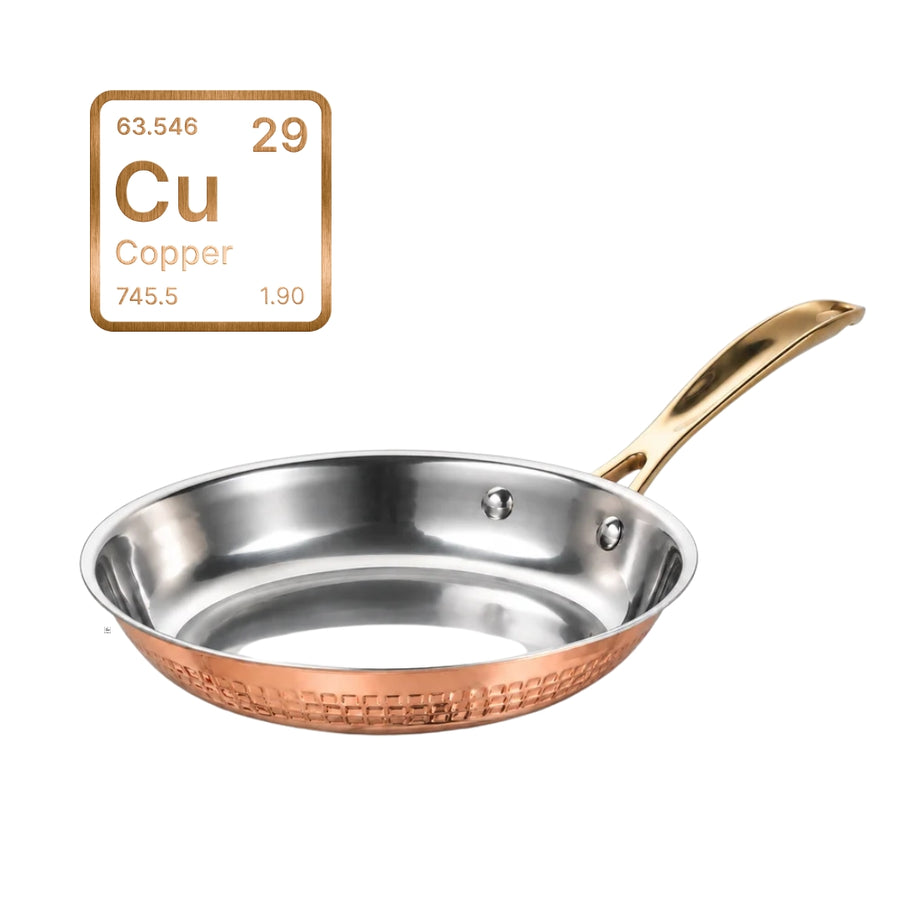
This pan is for the kitchen that has neither the gas hob nor the hobby. Copper on the outside, a multi-metal body underneath, and a non-reactive cooking surface with nothing sprayed on it. Works on induction. Acidic food fine. Nothing to re-tin. It darkens, and that is allowed.
Homework describes the list you were given, not anyone's craft. This is copper without the list.
How is this different from a traditional copper pan?
Traditional copper: solid copper, tin lined, gas only, polish and re-tin. This: copper on the outside, a multi-metal body, a bare non-reactive surface, induction compatible, no tin. Both darken; ours you can leave.
See who went before you
Reviews from verified buyers
Finally bought the copper pan. I had copper cookware sitting in saved tabs for years. Induction compatibility and the lack of a tin lining finally removed my two biggest objections.
Easier than traditional copper. I wanted the beauty and responsiveness of copper without owning cookware that felt like a restoration project. This hits that balance beautifully.
Made for a home kitchen. Gorgeous enough to leave out. Practical enough that I’m not afraid to cook dinner in copper. That’s the combination I wanted.
Real copper I don’t have to baby. I expected copper cookware to require more attention. Other than accepting that the exterior develops a patina copper has fit into my cooking routine easily.
Last chance to save...
This limited-time deal is in high demand.
Frequently asked questions
1. Is the outside real copper, or plated?
Real copper, not paint, foil or plating. That is the difference between this and the pan from the TV ad, whose own reviews say the colour lifts and the centre warps. Ours is built to be used and to darken, which paint cannot do.
2. What is the body made of?
Copper on the outside, a multi-metal body underneath that spreads the heat across the base, and a non-reactive cooking surface with nothing sprayed on it. We describe the construction as a whole rather than as a layer list, the same as we do for our titanium pans, and we would rather say that plainly than pretend otherwise.
3. How thick is the copper?
We do not publish layer measurements for any pan we sell, titanium included. What we put in writing is the construction: real copper on the outside, a multi-metal body, a non-reactive cooking surface with nothing sprayed on it, and a base that works on induction.
4. Is it nonstick?
No, and we say so before you buy. Nothing is sprayed on the cooking surface, so there is nothing to wear off, and that also means it is not nonstick. Heat the pan first, add oil, and let food release when it is ready rather than when you push it. Eggs want a little more fat and a little less heat than you think.
5. Does it work on induction?
Yes. The base is induction compatible, and it works on gas and electric as well. That is the one thing a copper pan is not supposed to do.
6. Will it tarnish?
Yes. Copper darkens with use and so will this pan, and we would rather tell you now than after. Two minutes with lemon and salt brings the shine back, or leave it and it turns a warm brown. Paint stays bright. Copper does not. That is how you tell them apart.
7. Can I cook tomatoes, lemon and wine in it?
Yes. The cooking surface is non-reactive, so acidic food is fine. There is no tin lining to wear through, so there is nothing to melt, nothing to re-tin and no point where the copper starts touching your food.
8. How do I look after it?
Hand wash with warm water and a little soap, and dry it rather than leaving it to drip. Lemon and salt when you want it bright.
© Gonest
Copper without the homework. Works on induction. Nothing to re-tin.