6 Reasons Why Thousands Of Health-Conscious Families Are Switching To Titanium Cookware


About the author
Daniel Hart spent years as a chef in kitchens across the world, where nonstick pans were treated as consumables: use them hard, watch the coating go, replace them. It was only when he started cooking for his own family that he asked what the flaking layer actually was, and went looking for a pan with nothing on it at all. That search ended at uncoated 100% Grade 1 Japanese titanium. Today he writes for people who read labels and want a straight answer about what their food is touching.
A quiet revolution in the kitchen
For decades, nonstick coatings ruled our kitchens, and every scratch raised the same quiet question. But a growing wave of home cooks and professional chefs is discovering what surgeons and aerospace engineers have known for years: titanium changes everything.
Reason #1
The coating is the part that fails
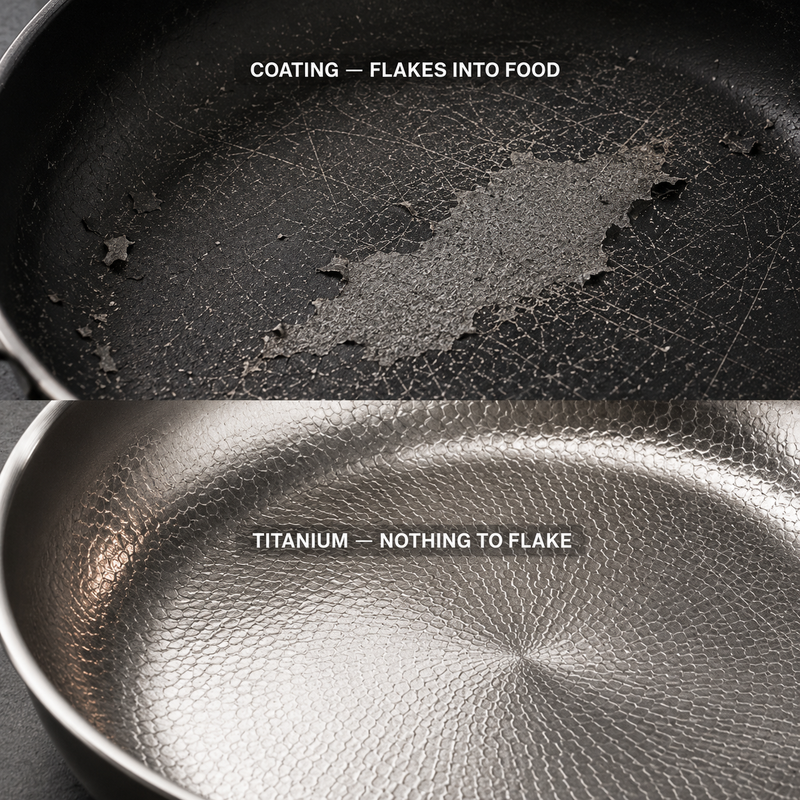
Every nonstick pan cooks on a coating, and a coating is a layer sitting on top of metal. Layers scratch. A metal spoon, a stack of pans in a cupboard, a scouring pad on a burnt bit, and the surface starts to go.
Once it does, the flakes have to go somewhere. Some end up in the pan. Some end up in the food. It is the reason people quietly bin a pan they otherwise liked, and the reason so many of us keep rebuying a product we no longer trust.
The uncomfortable part is that the coating was always going to fail. It is a consumable layer with a service life, sold as though it were the pan itself.
How do I know if my coating is going?
Look at the centre of the pan in good light. Fine scratch lines, dull grey patches, or any flaking at the edges mean the layer is breaking down. Once you can see it, it has been happening for a while.
Is a scratched pan still usable?
That is your call to make, and it depends how much of the layer is gone. What we can say plainly is that a pan with no coating has nothing that can scratch off in the first place.
Reason #2
No coating. Nothing to leach.
This pan does not have a better coating. It has no coating at all.
The cooking surface is titanium: uncoated, inert and non-reactive. It is the same property that makes titanium suitable for medical implants, where the material sits inside the body without reacting to it. Made without PFAS, PFOA or PTFE, because there is no polymer layer anywhere on the pan to contain them.
Nothing to flake. Nothing to leach. Just titanium, heat and a little oil.
Each pan is handcrafted in Japan, whose leading titanium industry supplies the medical and aerospace fields, and that same purity standard is applied to cookware.
What exactly is the cooking surface made of?
Grade 1 commercially pure titanium, uncoated. Not a titanium colour, not a titanium reinforced coating, not a treatment applied to another metal. The metal your food touches is titanium.
Is it really free from PFAS?
There are no fluoropolymers used at any stage of manufacturing, because there is no coating to put them in. That is a statement about what the pan is made of rather than a claim about what that means for you.
Reason #3
"Non-toxic" is not a specification
If you have been shopping for a cleaner pan, you have read a lot of soft words. Non-toxic. Chemical free. Kind to your family. None of them are defined, none of them are regulated, and none of them tell you what is on the pan.
Ceramic is where most people go next, and it deserves a straight answer. Ceramic nonstick is not solid ceramic. It is a sol gel layer, a silica based coating sprayed onto metal, and like every coating it has a service life. Many wear out faster than the PTFE pans people leave to buy them. If you have already switched once and watched the second pan fade too, that is not you doing something wrong. It is the same product architecture with a different name on the box.
Then there is the small print. There are pans marketed on titanium that disclose added PFAS in their own material information, on their own websites, a click or two below the headline.
So ignore the adjectives and ask the specification question instead: what is the cooking surface made of, and is anything applied on top of it. A brand that cannot answer plainly is telling you something.
Is ceramic nonstick not the clean option?
Ceramic nonstick is still a coating. It is a sol gel layer applied to metal, not solid ceramic, and it wears down with heat and use like any other coating. It may suit you perfectly well. The point is only that it is a layer with a service life, so the question of what happens when it goes still applies.
Does "PFOA-free" mean it is PFAS-free?
No. PFOA is one compound in a family of thousands. Most brands replaced it with other fluoropolymers in the same PFAS family, so a PFOA-free label can sit on a pan that still uses them.
What should I be asking a cookware brand?
Two questions. What is the cooking surface made of, and is there anything applied on top of it. Everything else is packaging.
Reason #4
Bought by people who read the label first

Gonest customers tend to be the ones who check. They have already swapped other things in the house for cleaner versions, they have read more about PFAS than they ever expected to, and they arrive here sceptical because the last three brands sounded confident too.
With a 4.8/5 rating from verified buyers, the most common note is not about performance. It is relief. The pan is one material, the answer to "what is on it" is nothing, and there is no small print underneath.
And you can check it yourself for 30 days. Cook on it, scrub it, put it through the dishwasher. If it is not what we have described, send it back.
What are people saying?
"I stopped trusting nonstick after the third pan started flaking. This has no coating to flake." | "I read the whole product page looking for the catch. There is not one." | "Six months of daily use, still the same bare metal."
Reason #5
Inert, so acidic food stays food
Titanium does not react. Tomato sauce, lemon, wine and vinegar all behave the same way in this pan as they would in a bowl: they sit there and cook. No metallic taste, no discolouration, no reaction with the surface.
That matters more than it sounds. Reactive pans quietly change the food in them, and coated pans are usually the ones with the longest list of things you are told not to do.
Here there is nothing to protect and nothing to react. It is one stable metal, at any temperature a kitchen can produce.
Can I cook tomatoes and lemon in it?
Yes, without any special handling. Titanium is inert, so acidic ingredients do not react with the surface, leave a taste, or mark it.
Does it stain or hold smells?
No. The surface is non-porous, so nothing soaks in. Garlic and fish rinse off rather than lingering.
Reason #6
It still releases food. Just not from a chemical.
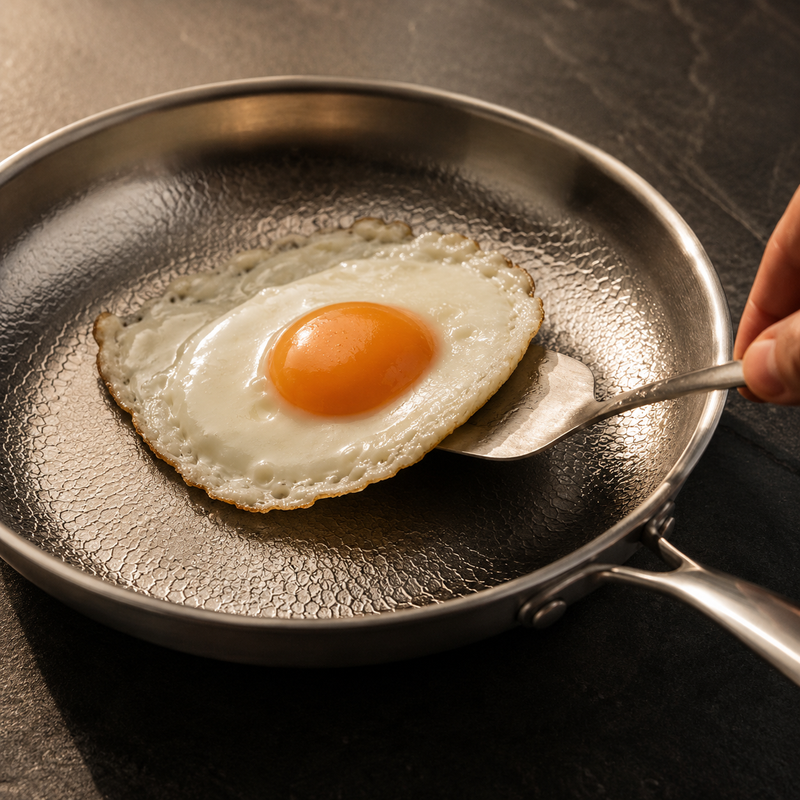
The honest question at this point is the practical one: if there is no nonstick coating, does everything stick?
No, and here is the mechanism. The surface is hammered, which reduces the contact area between the food and the pan, so food releases from the shape of the metal rather than from a layer applied to it. With a small amount of fat it behaves closer to a well seasoned carbon steel pan than to a brand new Teflon one.
The trade is worth understanding before you buy. It is not the slippery-from-the-box feel of a fresh coating. It is a release that never degrades, because there is nothing on the surface to degrade. A coated pan is at its best on day one. This one cooks the same in year ten.
Will eggs stick?
With a little fat and a properly preheated pan, eggs release cleanly. It is not PTFE slippery, and we would rather say that up front than have you discover it in your kitchen.
Do I need to change how I cook?
Slightly. Preheat before adding fat, use a little oil or butter, and give food a moment before moving it. That is the whole adjustment, and it does not change over the life of the pan.
See who went before you
Reviews from verified buyers
I threw out my last pan the day I noticed the scratches and then spent weeks not replacing it, because I didn't trust anything. This is the first pan where the answer to 'what's on the surface?' is nothing. That's the answer I was looking for all along.
I already switched once, to ceramic, because it was supposed to be the safe one. Eighteen months later it was fading like the Teflon did. This time I bought the pan with no layer at all. There's nothing left to wear off, so I'm done switching.
Every brand says non-toxic. I emailed this one and asked exactly what the cooking surface is made of, expecting the usual runaround. The answer was one sentence: uncoated Grade 1 titanium, nothing applied on top. No other brand answered me that plainly.
Honest review: you do need a little oil and a proper preheat, and they tell you that before you buy, which is exactly why I trusted the rest of what they said. Eggs release fine once you get the rhythm. I'll trade a spray-on coating for that every time.
Last chance to save
This limited-time deal is in high demand.
Frequently asked questions
Is there any coating on this pan?
None. The cooking surface is uncoated Grade 1 titanium. There is no nonstick layer, no ceramic layer, and no treatment applied on top of the metal.
Is it made without PFAS, PFOA and PTFE?
Yes. No fluoropolymers are used at any stage of manufacturing, because there is no coating for them to be part of.
Will food stick without a nonstick coating?
With a little fat and a preheated pan, food releases cleanly. The hammered surface reduces contact area, so release comes from the shape of the metal. It is closer to well seasoned carbon steel than to a new Teflon pan, and unlike a coating it does not fade.
Can I cook acidic food in it?
Yes. Titanium is inert, so tomato, lemon, wine and vinegar do not react with the surface, leave a taste, or mark it.
Can I use metal utensils?
Yes. There is no coating to scratch through, and titanium is harder than standard kitchen utensils.
Is it dishwasher safe?
Yes. There is no coating a dishwasher can damage, so hand wash or machine, whichever you prefer.
Does it stain or hold smells?
No. The surface is non-porous, so juices and odours sit on top and rinse away rather than soaking in.
What if I do not get on with it?
You get a 30 day trial. Cook on it in your own kitchen, and if it is not right, return it for a full refund.
© Gonest
Pure titanium. No coatings. No compromises.