Why People Are Done Replacing Their Pans


About the author
Daniel Hart spent years as a chef in kitchens across the world, where a pan was judged on one thing: whether it survived another service. Most did not. Somewhere between the scorched nonstick and the warped premium sets, he stopped replacing pans and started reading material specs instead. That is how he ended up on uncoated 100% Grade 1 Japanese titanium, which has no coating to fail and no reason to be replaced. Today he writes for people who would rather buy once.
A quiet revolution in the kitchen
For decades, our kitchens ran on pans designed to be rebought: coatings that thin, surfaces that fade, and a new pan every other year. But a growing wave of home cooks and professional chefs is discovering what aerospace engineers have known for years: titanium does not do disposable.
Reason #1
Most pans are built to be replaced
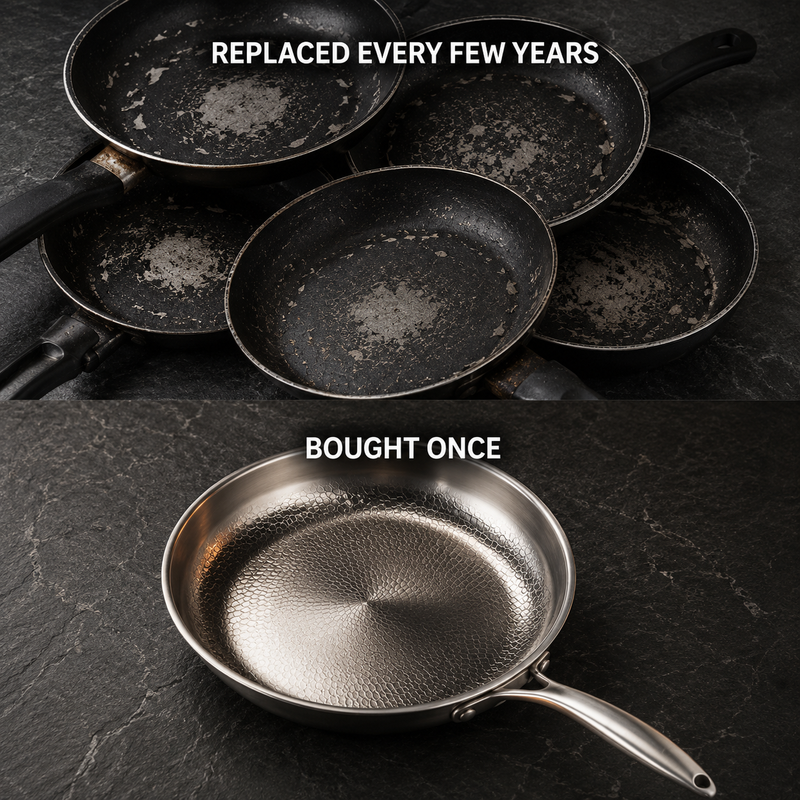
Count them. Most households go through a nonstick pan every year or two, and the pattern is always the same: it works beautifully, then it works less well, then the coating goes and the whole pan goes in the bin.
That is not bad luck or bad cooking. The coating is a consumable layer with a service life, and when it reaches the end of it, a perfectly good piece of metal gets thrown away because of the film that was sprayed onto it.
A category that sells you a pan every eighteen months has very little reason to sell you one that lasts twenty years.
Why do nonstick pans stop working?
The coating degrades. It thins with heat and use, scratches with utensils, and eventually stops releasing food. The metal underneath is usually fine, which is what makes it wasteful.
How much have pans actually cost me?
Most people are surprised when they add it up. Four pans over a decade at premium prices is a meaningful number, and it buys you the same thing four times.
Reason #2
Nothing on it wears out
This pan is titanium with no coating on it. That single fact is the whole durability argument, because everything that fails on a nonstick pan is the coating.
There is no layer to scratch, so metal utensils are fine. There is no film to break down at heat, so the oven is fine. There is nothing to thin out with washing, so the dishwasher is fine. Titanium does not rust and does not react.
The result is a pan that performs the same on day one and in year ten, not because we built it carefully, though we did, but because there is nothing on it that can change.
Each pan is handcrafted in Japan, where we build for decades of use rather than eighteen-month replacement cycles.
Can I really use metal utensils?
Yes, without thinking about it. There is no coating to protect, and titanium is harder than standard kitchen utensils.
Is it dishwasher safe?
Yes, every wash. Hand washing takes seconds, but there is no coating a dishwasher can damage, so it is your choice rather than a rule.
Reason #3
One pan, or another four
Here is the arithmetic this category avoids. A nonstick pan bought every eighteen months, across ten years, is roughly seven pans. Even at modest prices that is more than a good pan costs once.
Titanium costs more on the day you buy it. It costs less by the time the second nonstick would have failed, and after that the comparison stops being close.
There is also the part that is not about money. Seven pans is seven pans in landfill for one job that one pan can do. If planned obsolescence irritates you on principle, this is the version of the purchase that does not participate in it.
Why is it more expensive than a nonstick pan?
Because you are paying for solid metal instead of a coated base. The material is the value, and you buy it once instead of renting it in eighteen month instalments.
How long will it actually last?
Indefinitely, used normally. There is no degradation mechanism: no coating to wear through, no rust, no warping at kitchen temperatures.
Reason #4
Bought by people who are done rebuying

Gonest customers are rarely buying their first good pan. They are on their third or fourth nonstick, they know exactly how this ends, and they have decided to stop.
With a 4.8/5 rating from verified buyers, the review that comes up most is not excitement. It is relief. Months of daily use, dozens of dishwasher cycles, and the pan looks and cooks like it did at the start. Nothing to monitor, nothing to baby, nothing to replace.
Try it for 30 days. Use it hard, use metal in it, put it through the dishwasher. If it is not the last pan you buy, send it back.
What are people saying?
"Four nonstick pans in six years. This one ends that." | "Metal spatula, dishwasher, high heat. It does not care." | "It looks exactly the same as the day it arrived."
Reason #5
No rules, because there is nothing to protect
Read the care card that comes with a nonstick pan. Hand wash only. Soft sponges. No metal. Low to medium heat. Do not stack. Those rules are not there for your benefit, they are there to slow down the failure of the coating.
A pan that has to be handled carefully is a pan with something fragile on it. This one has nothing on it, so there is nothing you can do wrong.
Scrub it. Stack it. Put it in the oven and then in the dishwasher. You cannot shorten its life with the way you clean it, because there was never a layer to preserve.
Is there any maintenance?
None. No seasoning, no oiling, no special detergents. Rinse it or run it through the dishwasher.
Can it go in the oven?
Yes. Stovetop to oven with no coating to worry about at temperature.
Reason #6
A lifetime warranty that covers the whole pan
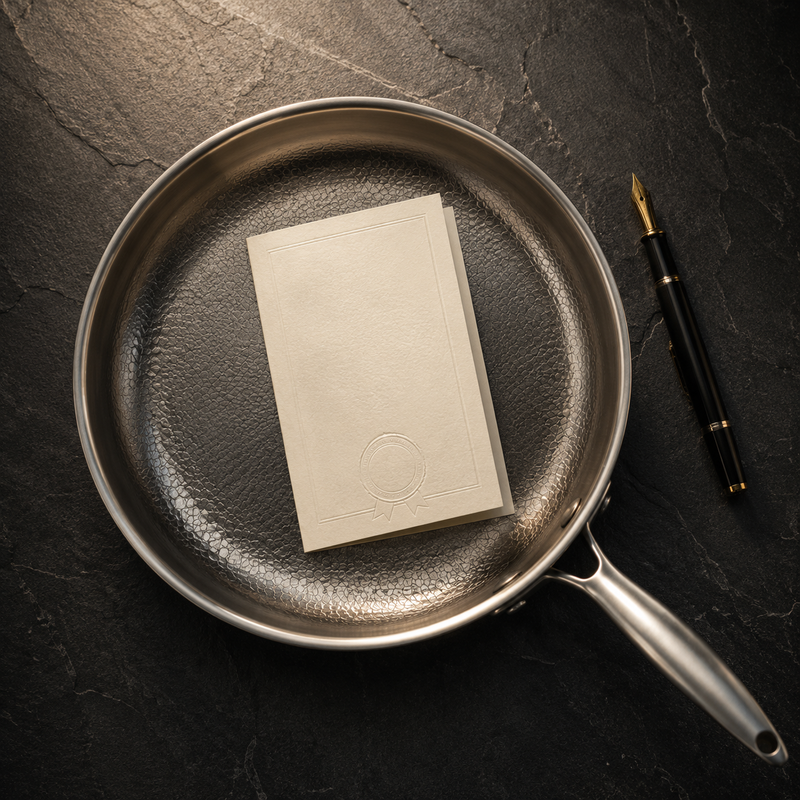
Warranties in cookware are where the confidence gets tested. Coated pans routinely exclude the cooking surface from coverage, which is a quiet admission: the manufacturer knows the coating will fail, so the one part that fails is the one part not covered. That is how a lifetime pan ends up with a twelve month surface.
Ours covers the cooking surface, in writing, for life. That is only possible because the surface is not a layer applied to the pan. It is the pan.
Buy it once, cook on it for years, pass it on. That is the entire proposition, and the paperwork says the same thing the material does.
What does the warranty actually cover?
The pan including its cooking surface, for life, under normal domestic use. Titanium cannot rust, warp at kitchen temperatures, or wear through, which is exactly why the promise is easy to make.
What if I change my mind?
You get a 30 day trial. Cook on it properly, and if it is not right, return it for a full refund.
See who went before you
Reviews from verified buyers
I did the maths before buying: five nonstick pans in nine years, all binned for the same reason. This cost less than those five combined and there's nothing on it that can go the way they went.
I decided to treat it badly on purpose for the first month. Metal spatula, dishwasher every night, straight from the hob into a hot oven. If it was going to fail I wanted it to fail inside the return window. It didn't blink.
Over a year of daily cooking now and it's identical to the day it arrived. Not 'still pretty good', identical. I keep checking the surface out of habit from my old pans and there's simply nothing happening to it.
I read the warranty before I read anything else. My last three pans covered everything except the surface, which is the only part that ever failed. This one covers the surface for life, in writing. That's the whole purchase decision right there.
Last chance to save
This limited-time deal is in high demand.
Frequently asked questions
How long does it actually last?
Indefinitely, used normally. There is no coating to wear through, titanium does not rust, and it does not warp at kitchen temperatures. There is simply no mechanism by which it degrades.
Can I use metal utensils?
Yes, without thinking about it. There is no coating to protect and titanium is harder than standard kitchen utensils.
Is it oven safe?
Yes. Stovetop to oven with no coating to break down at temperature.
Is it dishwasher safe?
Yes, every wash. There is no coating a dishwasher can damage.
Does it need seasoning or special care?
No. No seasoning, no oiling, no special detergents, no rules about sponges. Rinse it or put it in the dishwasher.
Why does it cost more than a nonstick pan?
Because you are buying solid metal rather than a coated base, once, instead of replacing a coated pan every eighteen months.
What does the warranty cover?
The pan including its cooking surface, for life, under normal domestic use. Coated pans usually exclude the surface, which is the part that fails.
What if I change my mind?
You get a 30 day trial. Use it hard, and if it is not the last pan you buy, return it for a full refund.
© Gonest
Pure titanium. No coatings. No compromises.